Showing posts with label JETwit. Show all posts

Thursday, December 5, 2013

JETwit - Making the Most of Your Network

Originally written for JETwit.com: http://jetwit.com/wordpress/2013/12/04/kitchers-cafe-003-making-the-most-of-your-network/#more-33014

Kitcher’s Café, a new series by Lana Kitcher (Yamanashi-ken, 2010-12) is an assortment of articles, topics and commentary written for the JET Alumni community. Lana currently serves as the Business Development Associate at Bridges to Japan, a New York-based cross-cultural consulting firm founded by JET alum Jennifer Jakubowski (Hokkaido, 1995-97). 

Dear recent JET returnees and current "job hunters,"
Cards.LinkedInI was given the opportunity to speak at the JETAANY Career Forum in New York City a few weeks ago. Approximately 25 recent returnees (plus JET alumni going through a career transition) attended the event and were able to learn from the presenters, and also from one another, about how to successfully land a job in today's economy. We learned that it is important to keep strategies current as technology continues to change and as the methods of yesterday are not necessarily effective for our search today.

I would like to share with you some of the points from my presentation called "Making the Most of Your Network," in case some of you are also going through this transition now. When I first returned home from the JET Program I had a really difficult time figuring out how to start the job search. At that point my only full-time job had been teaching English in Japan, and I didn't know how to start looking for a new job from scratch. It took me until mid February to get a job, and I really wish someone had told me what I needed to hear earlier.

I thought I was supposed to be applying to job posts and boards online, giving out my resume, and collecting business cards and LinkedIn contacts. After several weeks of searching and no hits (nope, not one interview), I was starting to feel desperate and under-qualified. I kept hearing from people that they had found their jobs on craigslist, or had applied online and gotten an interview. But this method clearly wasn't working for me, and I needed to change my strategy.

From that point I started doing extensive research, reading books and talking with people. Someone once told me that if I wanted to meet someone, I should invite them to lunch and offer to pay for the meal. (Ever seen an episode of MadMen?) I tried this advice, and started talking to people that I could learn from. It was through these connections that I was actually able to start building a real network, finally turning my hopeless job search into a successful one.

When it comes down to it, people are doing the hiring. Having a good resume is important, but submitting it blindly to hundreds of job postings doesn't mean that anyone will ever actually read it. Why not meet the people who can get to know you? Maybe they will know someone who is hiring and they can recommend you. Maybe they are actually hiring themselves and decide through your pleasant interaction that you would be a good fit for their company. Companies want to hire people they know and trust. Maybe your meeting will lead nowhere (now), but if nothing else it could be a great conversation, or practice for when it will count.
At the presentation, I passed around these resources for participants to use. Please feel free to view or download and print them yourselves if you think they can be helpful to you.
1) Networking Tips Sheet - This has several bullet points of items that I wanted to highlight, or didn't have enough time to cover during the presentation - tips to keep in mind.
2) Networking Resources Reading List - This list includes books that I have read or have had recommended to me regarding networking. It may seem strange to read about job hunting and networking, but in the long run it may be worth the time investment. Most of the resources should be available at your local library if you do not want to purchase a copy.

3) Networking Practice - When meeting new people or attending networking events, it is important to remember information about the people you meet. It is also important to follow up with them afterward. If you note commonalities, it will give you more  to connect on later. Consider using a worksheet like this to help keep track of new connections. For some, it may also be helpful to have a "goal" when attending events. I often tell myself that I need to meet at least three people by the end of the event. Since I am shy, this pushes me out of my comfort zone and allows me to strike up new conversations.
4) Making the Most of Your Network PowerPoint - It may not make a lot of sense alone, but I thought I would include it just in case you wanted to take a look.

If you are currently unemployed, I would recommend starting by meeting 2 to 3 people and attending one networking event each week. If you are pressed for money, schedule a few phone calls instead. Using technology such as e-mail, LinkedIn, and internet searches is a great way to start your research process, but the next step is to make those human connections. Find things that you have in common with that person. Do you share interests? How about alumni associations, previous jobs or locations? Do they do what you want to do? Ask them how they got there and what they might do differently if they could do it again. Learn from them and teach them about who you are without having to "sell yourself." They will learn about your experience and personality throughout the duration of the conversation and the relationship. Networking isn't about meeting as many people as you can as quickly as you can, but about creating human connections, and being able to sustain the relationships over time. How can you help them? How can you mutually benefit?

Words to redefine:

Informational Interview = Talking with people about what they do and how they got there. You're there to learn about them or their company.

Elevator Pitch = Knowing who you are and what direction you're thinking about going in. Don't try to fit your life story and qualifications into 30 seconds, but when the point comes and they ask you, "so what are you looking for?" you'll know the answer. There's nothing harder than trying to help someone who doesn't know what they want. Try some of the exercises from the book What Color Is Your Parachute to help you get there.

Networking = Meeting new people and sustaining relationships and connections over time. Teaching and learning, listening, helping, bridging.

So there you have it! If what you're doing isn't working, trying something new. Ask your friends and family what worked for them. I'll leave you with some advice that my friends told me:
  • “I met my boss at a meetup.com social event!”
  • “I attribute my success to LinkedIn, but not the job boards - just speaking with and reaching out to different people.”
  • “I started learning how to network when I stopped calling it “networking” and started calling it “meeting new people.”
  • “I found my current position by following the jobs posted on JETwit.”
  • “It’s very unlikely that someone will say no to a free meal, and if they say no – well, that’s the worst that could happen.”
If you have any additional hints and tips to share with fellow JET Alumni currently looking for employment, please share your ideas in the comments section below! We look forward from hearing from you and sharing our advice and experiences.

By the way, definitely utilize your JETAA and JETwit networks for your job search! There are new jobs posted weekly either by JETs, or by companies who love to hire JETs. Good luck!

Saturday, September 14, 2013

Tweet Mention

Mentioned by JETwit on Twitter!


Saturday, August 31, 2013

@LKConsultants - Roland Kelts

This is great. I was mentioned directly in a tweet by Roland Kelts, an author, journalist, and JET Alumni.

Thank you Roland!


Friday, August 30, 2013

JETwit article: Kitcher’s Café #002: Staying Connected

Article originally written for JETwit.com on August 30th, 2013. Official URL athttp://jetwit.com/wordpress/2013/08/30/kitchers-cafe-002-staying-connected/

Kitcher’s Café, a new series by Lana Kitcher (Yamanashi-ken, 2010-12) is an assortment of articles, topics and commentary written for the JET Alumni community. Lana currently serves as the Business Development Associate at Bridges to Japan, a New York-based cross-cultural consulting firm founded by JET alum Jennifer Jakubowski (Hokkaido, 1995-97)
Japanese Stationery

Although it has been a full year since my return, I continue to enjoy sharing stories and experiences with my friends from and in Japan. Recently, one of my old colleagues from Yamanashi visited New York for the first time and contacted me through facebook to meet up. I took her and her travel partner to "Penelope," a small restaurant on E 30th and Lexington Ave in New York. I was pleasantly surprised to see facebook photos of them going there for breakfast every day thereafter for the duration of their trip. It was a great and satisfying feeling to make these arrangements with her and be able to see the results.

As you are settling into a familiar state, maybe even feeling like your time in Japan was actually all a dream – you may wonder how it might be possible to keep up with your friends and colleagues that you met while in Japan. Thanks to social media, staying in touch has never been easier.

Sites like facebook and twitter, as well as new apps and technology such as Line or Skype, are perfect for keeping in touch with friends and maintaining connections over long distances. One site to consider is "Mixi," a Japanese networking site similar to "MySpace." According to The Japan Times Life section, Yahoo! Japan/Kakao Talk, Comm, Gree, and Mobage are also popular and commonly used in Japan. Although LinkedIn is not widely known in there yet, it is another option when trying to keep in touch with your professional contacts from abroad.

Along with social media networking, I would recommend keeping a list of names, e-mail addresses, phone numbers, and how you are connected to each person (in case you start to forget), and make an effort to occasionally reach out to the amazing people that you met along the way. You never know – perhaps you will need a recommendation for your Masters or PhD program. Maybe someone will be visiting your region and will want to reach out to you. It is even possible that someday you’ll go back to Japan to visit and want to reconnect with the individuals that made your time there special.

Another form of communication that many underutilize (in my opinion) is "snail-mail." Why not consider sending letters back and forth to Japan, making it a special activity? Mark Vanhoenacker recently wrote an excellent article in The New York Times OpEd section, making many points I agreed with about the value in writing letters by hand entitled “Dear Emma." Personally, I have had pen pals off and on since elementary school, the old fashioned way, and continue to value this method of communication highly over using computers. "A pen pal was a window into the world's endless collisions of similarity and difference," Vanhoenacker states. "Some things remain more valuable simply because they are hard to do... When I received a letter I would treasure it for hours, waiting for the right moment on the porch or by the fireplace to unseal what had traveled across seas, the Pacific, a week, or more of my life."

In addition to agreeing with Vanhoenacker’s argument, here are a few extra points for letter writing:

Why I Love Snail Mail

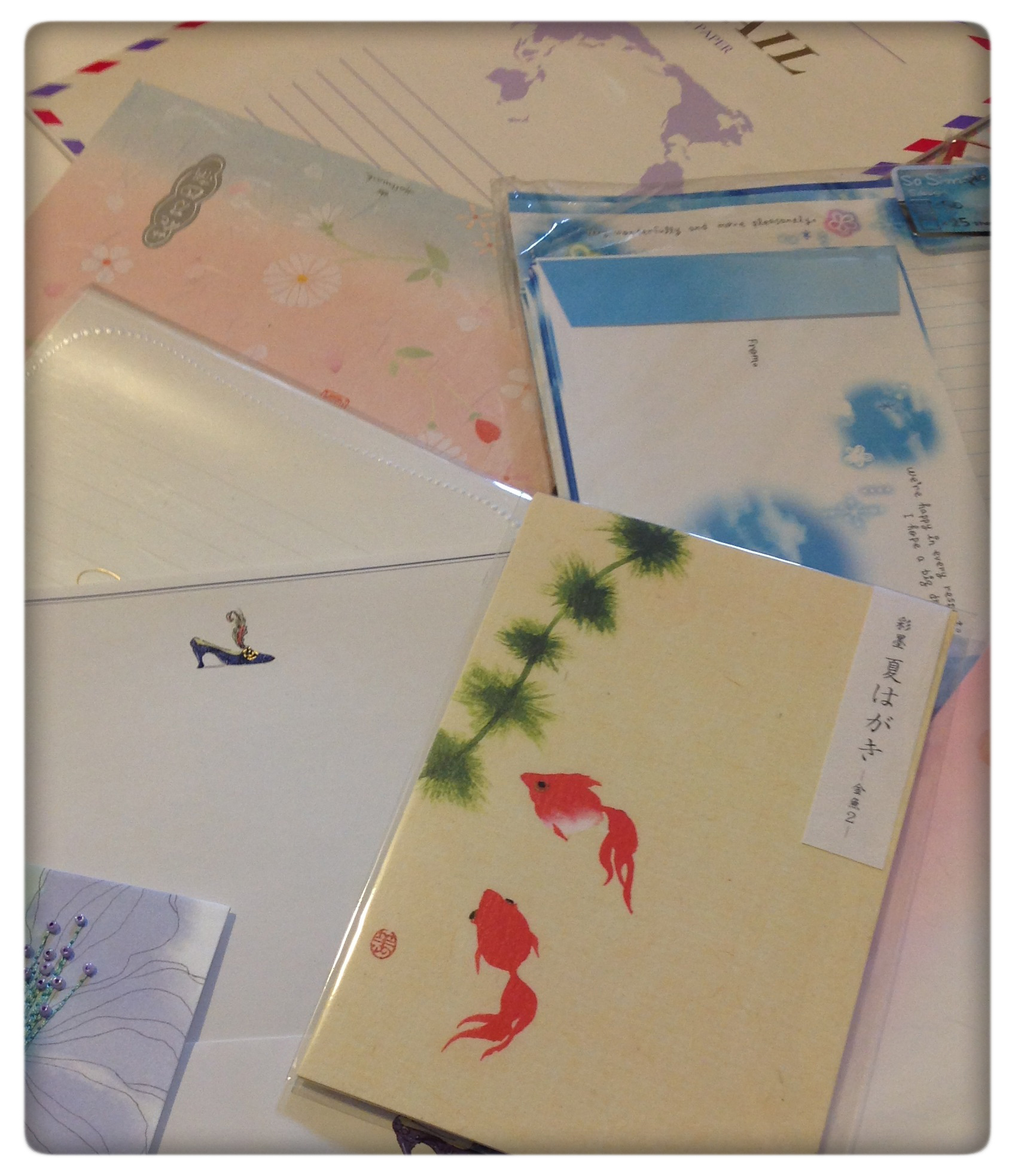
1) I adore stationery, especially the kind available in Japan. Luckily I can still get my fix at Kinokuniya, a Japanese bookstore.

2) The act of writing soothes me, and it feels like a special activity. I turn on some mood music, light a candle or two and make it a quiet time for reflection. My work requires me to be online and at the computer for most of the day, and getting away from that is a welcome change of pace.

3) Letters take time to be delivered. We live in an “instant gratification” era, but this can put us on overload. When I send letters to Japan, I enjoy the time between sending the letter and waiting for a response. For me, that beats sending and receiving hundreds of texts, e-mails, tweets, messages, pokes, tags, AGH!

4) I love opening the mailbox and there it is… a letter! Not a bill, not some junk mail, but a letter. And it’s addressed to me! I'm always so excited to go to the mailbox, an action that many only think about when they're expecting birthday checks or a shipment from Amazon.

5) I get to practice my seldom-used penmanship, and feel as though I'm offered a window into the other person's personality through theirs as well.

6) Sometimes a trip to the nearest postbox is a good reason/excuse to get out of the house and take a walk.

7) Although stamps are becoming more expensive, I still enjoy choosing the different kinds and seeing the new designs. Plus, stamps don't become collectible/valuable until they've been postmarked.

8) It's more personal than an e-mail. The person on the other end spent time, thought, and energy to write to me and I appreciate that. I know I have a good relationship with the people I write with, and that it will be a long-lasting one.

9) Although the government has the right to read material of question that goes through the mail, it still feels more private and intimate. If my letter gets hacked (aka opened), I won't lose my address book or passwords.

10) I feel like a completely real, open, and better version of myself when I write by hand. The words are a direct connection from my brain through my body, printed onto a physical piece of paper. I've noticed myself saying things that are out of character with technology because it doesn't feel real and I rush the interaction. Writing forces us to take off the mask and be who we are.

What ways have you found to stay in touch with your friends in Japan? What do you like or dislike about writing letters? Please feel free to share your questions, comments, opinions and experiences with readers in the comment section below.

Thursday, July 25, 2013

JETWit.com Kitcher’s Café #001: What we wish we had known – but now they can!

Kitcher’s Café is expanding! I'm now writing a section with the same name on JETWit.com. View my first post at the link, or by continuing below.

Original post from JETWit.com - July 25, 2013
"Kitcher’s Café #001: What we wish we had known – but now they can!"


Kitcher’s Café, a new series by Lana Kitcher (Yamanashi-ken, 2010-12) is an assortment of articles, topics and commentary written for the JET Alumni community. Lana currently serves as the Business Development Associate at Bridges to Japan, a New York-based cross-cultural consulting firm founded by JET alumJennifer Jakubowski (Hokkaido, 1995-97).

As I sat in my empty Yamanashi apartment, one year ago this month, a flood of feelings rushed over me. I had come full-circle, able to cram everything into two suitcases again with anxious yet excited feelings of leaving home for something unfamiliar. I had a bundle of memorabilia set aside to take with me, and pictures of the last days that I had with my students, coworkers and friends. I knew it was going to be hard to say goodbye and turn the page to the next exciting chapter of my life, but I didn’t think that it was going to feel so daunting. This was the first time in my life that the next steps were utterly unplanned and unpredictable. After high school I knew I was going to college, during college I knew I wanted to work for the JET Program… but now that the JET Program was over, the next year was a completely blank slate. I was going to have to return to my hometown temporarily to figure it out, and that idea to me was terrifying.
Japan, ALT, JET Program
As many of us have experienced, returning to your home country after any amount of time living abroad is more challenging than it may seem at first. They try to warn us about reverse culture shock, but we convince ourselves that “I will be different,” and “It won’t happen to me, I already know what to expect.” Some people really don’t experience any strange or frustrating feelings when returning home, but for individuals like myself, the first year back may be a challenging and rocky road.Many of the JETs that are in Japan right now are clearing out their desks, packing up their apartments, attending farewell parties, and being brought to tears by the students and coworkers that shared many moments with them this past year (or five). Where once was an unfamiliar, foreign and strange place, has become normal life. Do they realize that many of them are about to leave Japan, bound for an even stranger land – the one that they once called home?

As JET alumni, what do you wish someone had told you during your final days in Japan? What are some of the words of wisdom that you wish you had known before coming back? How can we help these transitioning JET participants, soon to join the alumni community? My advice to them would be this:

Try not to have unrealistically high expectations of how awesome going home will be, and don’t give up on yourself when things get tough. There may be challenges like living with family members, trying to find a job, readjusting to the foods and customs of your culture, but take them in doses and remember to step back and breathe when things might start to feel frustrating.

Also, the job market may still be a little more complicated than you are expecting. For many, the traditional ways of finding a job are now becoming the least successful. If you’ve spent weeks looking for jobs online and haven’t had any luck, start branching out. Talk to everyone you know and tell them your situation. Use networking groups, meetups, LinkedIn, and informational interviews. Meeting people in person and talking to those already in your networks is likely going to be your key into your next position. Also consider picking up a copy of What Color Is Your Parachute by Richard Nelson Bolles at your local library. When I was actively seeking help and networking in my community, this was the number one resource that my friends recommended. It gave me some practical statistical information to help me understand my odds of getting a job by applying online, and helped me think of new ways to approach the job market.

What kind of advice do you wish you had heard as you were finishing up the JET Program? Leave your comments in the space below, and give the new returnees a leg up as their tenure as an active JET Program participant comes to a close.

You can find out more about Reverse Culture Shock by reading Surviving in Japan: 10 Ways To Prepare For Reverse Culture Shock And Leaving Japan by Ashley Thompson (Shizuoka-ken, 2008-10), Community Manager for Nihongo Master and editor of Surviving in Japan.

-L

Sunday, August 5, 2012

Interview with Jennifer Jakubowski, Bridges to Japan

Although I've been back to the US for almost seven days now, I haven't found the time and or energy to update here in a while.  I'd still like to update about the whole transition from Japan to the US, but for now I'll just leave you with a quick update on something I was working on throughout the whole move.

I did an interview with the Founder and Managing Director of Bridges to Japan, Jennifer Jakubowski.  The interview has been published by JQ Magazine, a JETAA publication, and linked through JETwit.  Please take a moment to read the interview using either of these links, and feel free to comment and share!

JETAA JQ Magazine: Jennifer Jakubowski Interview
(Japan Exchange & Teaching Program Alumni Association of New York)

JETwit.com: Jennifer Jakubowski Interview

-Lana